Full Guide · Data Protection
The Full Guide to Data Protection and GDPR for Healthcare Organisations
How UK GDPR applies to healthcare providers: special category data, lawful bases, patient rights and the mistakes that trigger ICO attention.
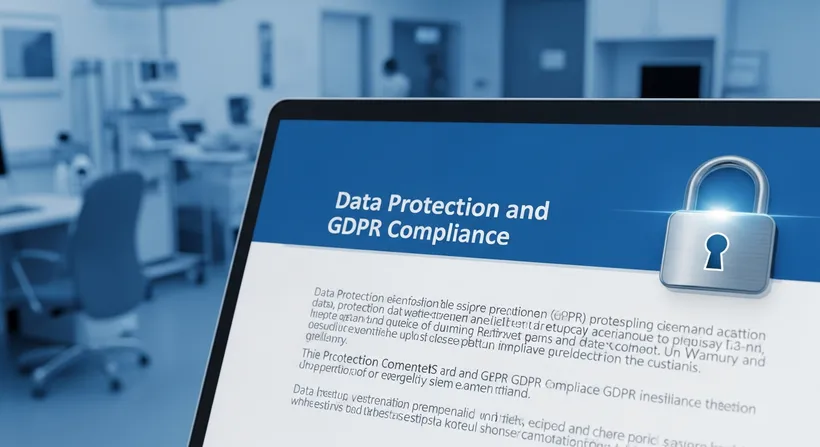
Healthcare organisations handle some of the most sensitive personal data that exists: health records, safeguarding notes, mental health history and treatment plans. UK GDPR classifies this as special category data, which carries additional legal requirements beyond standard data protection. This guide covers what that means operationally.
Understand your lawful basis, and document it
Every piece of health data you process needs a documented lawful basis, typically either consent, or processing necessary for health or social care purposes under Article 9(2)(h). The mistake most organisations make is relying on an assumed basis without writing it down. If a data subject access request or an ICO enquiry arrives, “we always processed it this way” is not a defensible answer. A one-page record of processing activities, kept current, solves this.
Map where patient data actually lives
Most healthcare organisations underestimate how many systems hold patient data: the clinical record system, email, shared drives, printed files, referral letters, even WhatsApp groups used informally by staff. A proper data map, listing every system, what it holds, who can access it and how long it is retained, is the foundation of GDPR compliance. Without it, you cannot answer a subject access request accurately or assess breach risk.
Apply the principle of least access
Not every staff member needs access to every record. Access should be scoped to what someone actually needs to do their job, reviewed periodically, and revoked promptly when someone changes role or leaves. This is one of the simplest controls to implement and one of the most commonly neglected, particularly in smaller organisations using shared logins for convenience.
Have a genuinely usable breach response plan
A data breach response plan that exists only as a document nobody has read is not a plan. UK GDPR requires notifiable breaches to be reported to the ICO within 72 hours. That clock starts the moment you become aware, not when you finish investigating. Your plan needs to specify who assesses severity, who makes the notification decision, and who communicates with affected patients, and your team needs to know this before an incident happens.
Handle subject access requests within the statutory timeframe
Patients have the right to request a copy of their data, and organisations have one calendar month to respond, extendable in complex cases. For organisations still manually searching through email inboxes and shared drives to fulfil these requests, the process is slow, error-prone, and creates compliance risk if the deadline is missed. Centralising records and having a defined SAR process shortens this significantly.
Third-party processors need contracts, not assumptions
If you use external suppliers who touch patient data (transcription services, IT support, cloud storage, an AI tool), you need a data processing agreement in place, and you need to have actually checked what safeguards that supplier has, rather than assuming compliance because they are a reputable brand.
Build privacy into new systems from the start
Data protection by design means considering privacy implications before you deploy a new tool or workflow, not retrofitting it afterwards. Before adopting any new system that touches patient data, ask what data it will hold, where it is stored, who can access it, and what happens to that data if you stop using the tool.
Getting these fundamentals right protects patients, reduces regulatory risk, and in most organisations also reduces the administrative burden of manually tracking data across disconnected systems.
This guide is general information for UK healthcare organisations, not legal or regulatory advice specific to your organisation. Always confirm requirements against current CQC, ICO and sector-specific guidance.
Want this applied to your organisation specifically?
The Operations Audit identifies where administration is costing your organisation time and risk, with a prioritised plan. £1,500. 24-hour turnaround.
Book an Operations Audit